My first international travel as a freelancer in the Philippines was nothing short of a happy, yet chaotic experience. Nothing went exactly as planned or how I imagined it would be… but somehow, everything still worked out the way it was meant to.
Being a freelancer in the Philippines can be challenging in all aspects of adulting—from opening a savings account, getting a credit card, to actually traveling abroad. Everything needs to be properly documented, and there always has to be proof of financial capacity and legitimacy.
5 Most Important Things to Prepare for your First International Travel as a Freelancer
Taiwan was the first country I visited, and here are five of the most important things I prepared for my first international travel as a freelancer in the Philippines.
Acquire “Freelancing” Legalities
Personally, the most important foundation you can have as a full-time freelancer in the Philippines is to make your work legal as a business.
Yes, I mean register it!
Before my first international travel, I was already a BIR-registered freelancer (yes, I pay my taxes 😌). This helped me build credibility and demonstrate financial capacity when needed.
Here are the documents I had to support my legitimacy and compliance:
- BIR Certificate of Registration
- DTI Registration
- Recent Client Contract / Service Agreement
- 6 months of Client Invoices
- 6-month Bank Certificate and Bank Statements of Account (from the account where I receive my paychecks)
- BIR-stamped ITR with receipt
- Financial Statement of Assets and Liabilities
- Business Bank Account (under my business name)
- A copy of my business official receipt
It’s different for every freelancer—you may not need all of these.
In my case, I don’t have a COE (Certificate of Employment) since I work as an independent contractor and not as an employee of my clients.
What matters most is that you can prove consistency, income, and legitimacy. Whatever documents that support your situation, that’s what you bring.
Book Pre-Travel Stuff
Before anything else, make sure your trip actually looks like a real, well-planned trip. This is one of the easiest ways to build confidence—not just for yourself, but also when answering questions at immigration.
For my first international travel as a freelancer in the Philippines, I made sure everything was booked, confirmed, and easy to show when needed.
- Passport – Must be valid for at least six months beyond your return date.
- Confirmed Roundtrip Flight
- Day-to-day Itinerary
- Confirmed Hotel Booking
- Activity/Tour Vouchers and Tickets
- Travel Insurance – Strongly recommended for medical emergencies and trip cancellations.
You don’t need to overcomplicate this. As long as your documents are legit, organized, and aligned with your travel story—you’re good.
Dig Deep Digital for Supporting Documents (Just in Case)
These may seem like small details, and honestly, immigration might not even ask for them, but having these ready gave me peace of mind.
When it’s your first time traveling outside the Philippines as a freelancer, it’s better to be overprepared than underprepared.
Here are extra proofs I prepared to support my claims:
- Email thread between me and my recent, existing client
- Payment notification emails
- Screenshots of Zoom meetings (if any)
- Photos with the friends you’re traveling with (bonus if posted on social media with timestamps)
Think of this as your “backup layer.” You may never need it but if you do, you’ll be glad you have it.
Know How To Answer During the Philippine Immigration Interview
We’ve heard so many horror stories about first-time travelers getting offloaded, doing the second interview, and waiting for long hours to pass through the Philippine Immigration.
While it feels like power-tripping, we should also understand that they’re also just doing their job to protect us from getting harmed abroad.
Millions of Filipinos travel overseas every year for work and leisure, and while most do so legally, not everyone’s journey turns out as planned. Some fall victim to illegal recruitment, misleading job offers, or abusive employers, which can push them into undocumented situations that are difficult to track.
So, here are the best practices on how to answer during the Philippine Immigration interview:
- Honesty is the best policy. Whether you lie or not, they’ll know.
- Answer only what is asked. One question, one answer. No need to overshare your life story.
- Don’t overdo the documents. Do you have to print out your travel documents?No. You’re not applying for a job. Skip the bulky envelopes. Your phone is your best friend.
- Keep everything digitized. Compile your documents in one folder for easy access.
- Have your essentials ready. Your emails and bank apps should be easily accessible.
- Know your itinerary. If you planned it yourself, easy. If not, take time to review it so you don’t look lost when asked.
- Look the part. Stay composed. Nerves are normal, but how you present yourself matters. Dress well. It boosts confidence, and confidence shows.
What are the common Immigration Questions?
- Where are you traveling, why, and how long will you stay?
- What do you do for a living?
- Who are you traveling with and how are you related?
- How will you fund your trip?
Immigration interviews aren’t meant to scare you. They’re simply there to ensure everyone traveling is doing so for the right reasons. So take a deep breath, trust your preparation, and enjoy this moment because you’re finally taking that first step into seeing the world on your own terms.
Plan Your Airport Outfit. IT MATTERS.
What you wear at the airport? Yes, it matters more than you think.
I almost didn’t make it to my flight, and maybe, just maybe, how I looked and presented myself helped me get through that entire chaotic experience.
It’s proven and tested (by me 😌): how you present yourself can give you that extra edge.
The Davao–Taipei via Manila flight kept changing that time because of the global cyber outage that resulted in multiple flight cancellations.
My Davao to Manila flight, scheduled at 6 PM, was cancelled—but the Manila to Taipei flight at 11 PM wasn’t. I was already at the airport around 4 PM because I knew it was going to be crowded.
By the time I got to the check-in counter, all they could offer me was a refund. But I kept insisting to be transferred to the next available flight to Manila, explaining that it was my first time traveling internationally and I had already paid for everything. I didn’t want it to go to waste.
Even though I knew it wasn’t the airline’s fault, I stood there trembling, heart pounding, trying to stay composed while asking if there was any other way. I really needed to fly out.
Then, a Cebu Pacific ground staff approached me and asked if I was traveling alone. She said she might get me on an 8 PM flight—if one passenger didn’t show up. It was a full flight. And honestly, that was the first time I felt so evil… thinking, “I hope someone doesn’t make it.” 😭
I didn’t want to get my hopes up, but I stayed. Maybe something would happen.
And something did… miraculously.
She told me to go through security as fast as I could because boarding had already started. I brought all my luggage to the boarding area and waited.
I had to wait until all passengers were boarded and last calls were made. Only then could they decide if I could get on the flight—they call it a “chance passenger.”
And I made it. Huge thanks to the Cebu Pacific crew who stayed with me and helped me get on that plane.
But the adrenaline didn’t end there.
My Manila–Taipei flight was at 11 PM, and we landed at 10 PM. Imagine the running, the luggage claim, and the loooong immigration line—all within an hour.
I practiced my immigration Q&A so much, but when I got there, it felt like a blur. A few questions—and I was through.
Lucky? Maybe. But also—I was prepared.
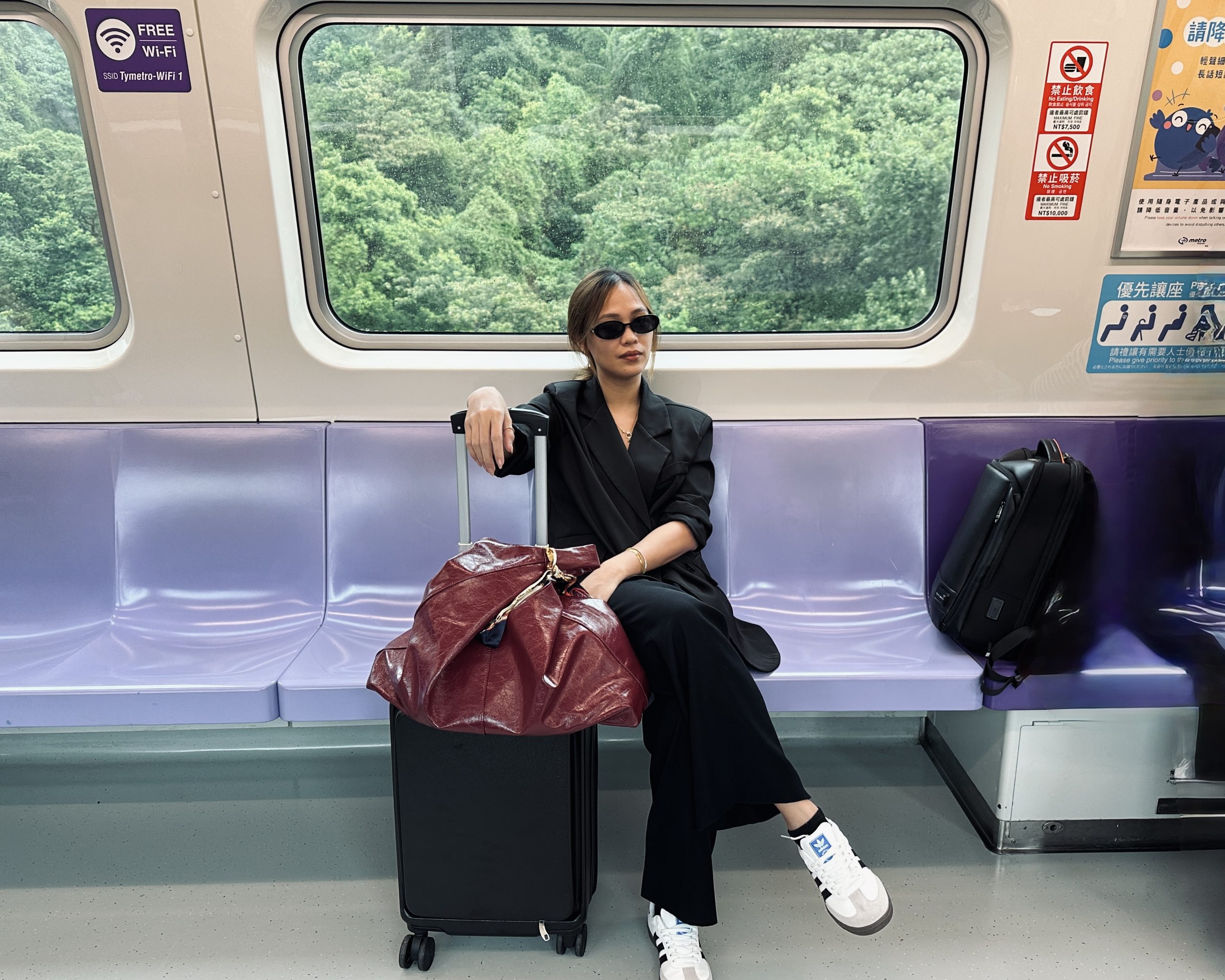
And I made sure to look the part: tourist-looking, but put together.
I truly believe dressing well gave me an edge—from being accepted as a chance passenger, to skipping a long immigration line, to having a smooth interview as a first-time international traveler.
Yes, dressing properly at the airport matters—especially for first-time travelers.
So, what should you wear on your first international travel experience as a freelancer in the Philippines?
Simple: tourist-looking, comfortable, but put together. Think: clean, effortless, confident—not trying too hard, but not careless either.
Your first international travel as a freelancer in the Philippines can feel a bit intimidating, especially when you don’t have the “traditional” documents that employees usually present. But as long as you’re prepared, honest, and confident in your travel plans, there’s really nothing to be afraid of.
Goodluck on your travel!