I have always been in love with the ocean since I was young. Not sure if it’s because I’m a water Pisces girlie, but I’ve always been drawn to the sea. I love being in it, but at the same time, I’m honestly scared of it. I know, it’s ironic.
My first underwater experience wasn’t through freediving but scuba diving. I tried it for a tourism campaign, and around that same time, freediving was becoming increasingly popular in the Philippines.
At first, it was simply another activity I wanted to experience and promote as a travel blogger. But somewhere between learning how to equalize, descending on a line for the first time, and seeing the underwater world on a single breath, I fell completely in love with the sport.
Since then, I’ve explored different freediving destinations around the Philippines, met amazing people in the freediving community, and learned lessons that go far beyond depth and breath-hold time.
If you’re curious about learning freediving, this beginner’s guide will walk you through everything you need to know before taking your first course.
What is Freediving?
Freediving is the sport and practice of diving underwater while holding your breath without the use of scuba tanks or breathing equipment.
One of my favorite ways to explain the difference between scuba diving and freediving is through a phrase commonly taught in both sports.
In scuba diving, instructors constantly remind you: “Never hold your breath.”
In freediving, you’re literally diving on a single breath.
That simple statement already shows how different these two underwater disciplines are.
While some people associate freediving with deep diving records and competitions, recreational freediving is often about exploring reefs, improving water confidence, swimming alongside marine life, and experiencing the ocean in a more natural way.
Quick Facts About Freediving
Before we dive deeper into this beginner freediving guide, here are some quick facts:
- No oxygen tank needed
- Suitable for beginners and many non-swimmers
- Can be learned through discovery lessons and certification courses
- Requires only three basic gears: a low-volume mask, J-type snorkel, and long fins
- Typical beginner course duration: 2 days
- Beginner course cost starts at around ₱3,000
- More about relaxation than physical strength
- One of the fastest-growing water sports in the Philippines
Is Freediving Safe for Beginners?
Generally, yes.
Freediving can be a very safe sport when learned properly under trained professionals. That’s why it’s important to take an introductory freediving course with a certified instructor or a reputable freediving school before diving on your own.
A proper beginner freediving course doesn’t just teach you how to hold your breath. More importantly, it teaches safety procedures, buddy systems, equalization techniques, recovery breathing, and how to recognize your limits.
Like any adventure sport, there are risks involved. However, most risks can be significantly reduced through proper education and responsible diving practices.
One of the most important rules in freediving is simple: Never dive alone.
Even experienced freedivers follow this rule.
Can Non-Swimmers Learn Freediving?
Yes, absolutely. Many freedivers started as non-swimmers or people who weren’t particularly confident in the water. In fact, I still can’t confidently swim without fins.
What surprised me most about freediving was how different it felt from traditional swimming. Freediving taught me how to relax, float comfortably, and become more familiar with open water environments.
Over time, spending more time in the sea helped me become more confident in the water. While basic swimming skills can certainly help, not being an expert swimmer shouldn’t stop you from learning freediving.
What Happens During Your First Freediving Course?
From my experience, my introduction to freediving course lasted for two days. Although every freediving school has its own structure, here’s a typical beginner course flow.
Day 1 - Theory Session & Pool Training
- Registration and Orientation – You’ll meet your instructor, complete registration requirements, and get familiar with the course flow.
- Theory Session – This is where you’ll learn the fundamentals of freediving, including breathing techniques, pressure, equalization, safety protocols, and proper diving practices.
- Breathing and Safety Training – You’ll learn relaxation exercises and safety procedures that are essential for freediving.
- Pool Training – Most beginner courses include pool sessions where you can practice techniques in a controlled environment.
- Assessment – Your instructor will assess your understanding of the concepts and skills introduced during the day.
Day 2 - Open Water & Fun Dive Session
- Stretching and Warm-Up – Many schools begin with light stretching or yoga exercises to help you relax before entering the water.
- Open Water Line Training – This is usually the most exciting part of the course. Open water training takes place in the sea, often early in the morning when conditions are calmer. You’ll descend and ascend using a training line while applying what you learned during the theory session. For most beginners, the goal isn’t depth but comfort and technique. Many students reach depths between 7 and 10 meters during their first course. Don’t pressure yourself. Everyone progresses at a different pace.
- Rest and Progress Assessment – After the morning session, you’ll rest, hydrate, and discuss your progress with your instructor.
- Fun Dive Session – This is where you’ll practice diving without the line while learning proper duck dive techniques. For many beginners, this is also where they get their first underwater photos and videos.
FREEDIVE TRIBE PH: Camp, Dive, Yoga, and Work from the Beach in Batangas
Basic Freediving Terms Every Beginner Should Know
Before continuing your freediving journey, it’s helpful to understand some common terms you’ll hear during training.
Freediving Disciplines
- Constant Weight (CWT) – A discipline where you descend and ascend under your own power using bi-fins or a monofin without pulling on the line.
- Free Immersion (FIM) – A discipline where you descend and ascend by pulling yourself along a rope.
- Static Apnea (STA) – Holding your breath underwater for as long as possible without swimming or moving.
- Dynamic Apnea (DYN) – Swimming horizontally underwater to cover the maximum distance possible on a single breath.
Other Important Terms
- Duck Dive – The technique used to enter the water headfirst efficiently before descending.
- Equalization – The process of balancing pressure in your ears and air spaces as you dive deeper.
- Recovery Breathing – A breathing technique performed immediately after surfacing to help recover safely.
- Buddy System – A safety practice where divers monitor and support each other during dives.
Where to Learn Freediving in the Philippines
One of the best things about learning freediving in the Philippines is that there are now excellent destinations across the country.
Luzon Freediving Schools
If you’re based in Luzon, Batangas is the place to be. It’s the heart of the freediving community here, and there are so many schools that love teaching beginners.
- Maximum Freediving (Batangas)
- Lakbay Freediving (Batangas)
- Kataw Freediving (Batangas)
- Freedive Tribe PH (Batangas)
- Palaone Freediving (Coron)
Visayas Freediving Schools
Visayas has the widest range of freediving schools. If you’re island-hopping through Visayas, these are the spots to check out:
- Pacific Blue Freediving (Cebu)
- Tats Freediving (Siquijor)
- Lawud Freediving (Dumaguete City)
- Anima Freediving Academy (Dumaguete City)
- Kauban Freediving (Panglao, Bohol)
Mindanao Freediving Schools
Mindanao has fewer formal schools compared to the other islands, but the community here is so tight-knit and welcoming. You can choose the one closest to your home base:
- Davao Freediving (Samal Island, Davao del Norte)
- Aquavita Freediving (Samal Island, Davao del Norte)
- Padayon Freediving (Mati, Davao Oriental)
Honestly, the best place to learn freediving is often the destination closest to you. Consistency matters more than traveling far for your first course.
How Much Does It Cost to Start Freediving in the Philippines?
It really depends on your goals. Many schools offer programs under agencies such as Molchanovs, AIDA, SSI Freediving, or PADI Freediver.
Molchanovs is one of the most popular systems in the Philippines.
- Introductory Freediving Courses – Most beginner-friendly discovery courses start at around ₱3,000. These are ideal if you simply want to experience freediving before committing to a certification program.
- Certification Courses – For those who want to continue their education, certification courses typically range from ₱10,000 to ₱16,000. Most recreational divers continue through levels such as Wave 1, Wave 2, and beyond depending on their goals.
- Instructor and Advanced Programs – Divers who want to teach freediving or participate in competitive freediving can continue into higher-level training and instructor certifications.
- Fundives – Fundives typically range from ₱1,500 to ₱3,000 depending on the location and inclusions.
- Freediving Gear Costs – Long fins can range from around ₱1,000 for beginner plastic fins to over ₱30,000 for premium carbon fiber fins. Low-volume masks typically cost between ₱350 and ₱8,000. J-type snorkels usually range from ₱400 to ₱1,500.
Do I Need My Own Freediving Gear?
Not necessarily. Most introductory freediving courses already include the use of basic equipment such as a mask, snorkel, and fins. This allows beginners to try the sport before spending money on equipment.
If you decide to continue freediving regularly, these are the first three pieces of gear I recommend buying:
- Long fins
- Low-volume mask
- J-type snorkel
These gears are available at Salt and Sun Lifestyle, Badfish Dive Gear, Budolero, Ysla Freediver Shop, and Sanghinga.
Additional gear you can invest in later includes:
- Wetsuit
- Weight belt
- Neck weight
- Dive socks
- Fin bag
You don’t need expensive gear to enjoy freediving. Some of my most memorable dives happened using very basic equipment.
How Long Does It Take to Become Good at Freediving?
It depends. Every diver progresses differently.
During my first freediving experience, anxiety kicked in hard. It took me time to become comfortable with depth and being underwater on a single breath.
The more time you spend in the water, the more familiar and natural everything starts to feel. Eventually, you’ll become more comfortable with equalization, depth, and the silence of being underwater.
One lesson I’ve learned is that depth isn’t everything. Focus on technique, safety, and enjoying the experience first. The personal bests can come later.
Common Beginner Mistakes
Most beginners make similar mistakes when starting their freediving journey.
- Skipping Equalization Practice – Equalization is a skill that improves through practice. Don’t wait until you’re already underwater to work on it.
- Chasing Depth Too Early – Depth should never be your primary goal as a beginner. Focus on comfort, relaxation, and proper technique.
- Buying Expensive Gear Immediately – You don’t need premium carbon fins on your first day. Learn the sport first before investing heavily.
- Comparing Yourself to Other Divers – Everyone progresses differently. Focus on your own journey.
- Ignoring Safety Protocols – Practices like recovery breathing and proper surface intervals exist for a reason.
- Diving Alone – Never dive alone. Always dive with a buddy or within a supervised environment.
- Focusing Too Much on Photos – It’s okay to want great underwater photos, but don’t let social media become the reason you’re diving.
Marine Life Encounters and Ocean Etiquette
One of the best parts of recreational freediving is encountering marine life in its natural habitat. However, being a responsible freediver also means respecting the underwater environment.
- Avoid touching turtles, corals, rays, and other marine animals.
- Don’t chase wildlife for photos.
- Never stand on coral reefs.
- Maintain awareness of your surroundings and leave no trace behind.
As freedivers, we spend so much time enjoying the ocean. The least we can do is help protect it.
Frequently Asked Questions Before You Start Freediving
When I was starting, I had a million questions buzzing in my head. Here are the most common questions I always get asked.
It is the best investment you can make to enjoy freediving. Taking this course is truly the moment everything clicks. You learn the science behind breath-holding and, most importantly, safety protocols.
Freediving is as safe as you make it. Diving alone is dangerous and non-negotiable—never do it. When you follow the safety rules, dive with a properly trained buddy, and respect your limits, it is very safe. The risks come when people skip the training and try to push too deep, too fast.
Definitely, not. I’m not a good swimmer myself! You should just be comfortable and confident in the water. The intro to freediving course will teach you proper finning and movement, which are more about efficiency and technique than raw strength.
It varies wildly, but your instructor will likely ask you to aim for 5 to 10 meters. Honestly, the number doesn’t matter. What matters is a comfortable, safe, and fun dive. Don’t compare yourself to others. Your personal journey is what matters. My first successful dive was 9 meters, and I felt like I had conquered the world!
As someone who has experienced both, I personally find scuba diving harder. However, they’re completely different sports and require different skills.
If you’re pursuing competitions, you’ll likely train regularly.
For recreational freedivers like me, occasional trips can still be enjoyable. I actually stopped freediving for almost a year and lost confidence in my depth. When I came back, it felt like I was starting over. But surprisingly, my body still remembered many of the techniques.
That’s when I realized how much I missed being underwater.
Not necessarily. Freediving is more about relaxation and technique than athletic performance. However, general fitness can improve your overall experience.
Best Freediving Destinations in the Philippines
Once you’ve completed your beginner freediving course, you’ll probably start looking for your next adventure.
Here are a few of my personal freediving dive guides in the Philippines. Read my freediving experiences on the best dive spots with a sample itinerary and expenses.
- FREEDIVING IN BOHOL: 7 Best Dive Spots, Dive Guide, Itinerary & Budget
- FREEDIVING IN SIQUIJOR: Home of Majestic Barracudas and Cave Diving
- FREEDIVING IN CORON PALAWAN: 6 Best Reef and Wreck Dive Spots
- FREEDIVING IN CAMIGUIN: Mantigue Island
Being recognized as the “Asia’s Leading Dive Destination”, the Philippines is truly a freediver’s paradise. I’ve spent months exploring these islands.
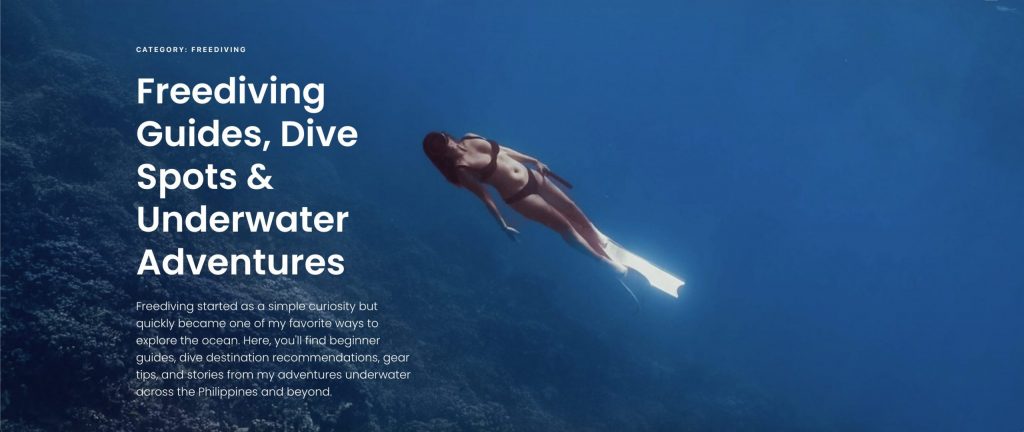
Freediving has taught me patience, presence, and a deeper respect for the ocean. It has also changed how I look at life outside the water.
Somewhere along the way, I stopped comparing my progress to others. I learned to move at my own pace, enjoy the process, and appreciate experiences for what they are. These days, living a slower life in Davao City feels just as rewarding as chasing another personal best underwater.
If you’re curious about learning freediving, don’t worry about your age, your fitness level, or whether you’re “ready.”
Take that first course. The ocean might surprise you the same way it surprised me.